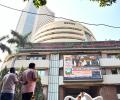
'BSE has facilitated nearly Rs 35 trillion in capital raising across multiple segments.'
Sebi aims to stay proactive as HFT and quant firms like Citadel Securities, Optiver, Millennium, and IMC Trading are expanding rapidly in India, which is home to the world's largest derivatives market by contracts traded.

Promoters of India's top private listed companies have cut their stakes sharply since 2021, taking advantage of elevated valuations and reshaping ownership dynamics in the market. Holdings of promoters in the top 200 privately owned listed firms declined nearly 600 basis points (bps) to 37 per cent at the end of FY25, from 43 per cent in FY21.

The interplay between domestic and foreign capital will shape India's equity markets.

Domestic institutional investors (DIIs), mostly mutual funds and insurance companies, overtook foreign portfolio investors (FPIs) in ownership of NSE-listed companies in the March quarter of 2025. According to Prime Database, DIIs held a 17.62 per cent stake, up from 16.89 per cent in the December 2024 quarter.

When Gensol Engineering made its public market debut through a small and medium enterprises (SME) initial public offering (IPO) in September 2019, its promoters held a commanding 96 per cent stake. Now, that figure has shrunk to a "negligible" fraction.

Global brokerage CLSA has lowered its target price for IndusInd Bank from Rs 1,200 to Rs 900 while maintaining an outperform rating on the stock after the private lender disclosed a net worth hit of Rs 1,500 crore due to an accounting gap. The revised price target still implies an upside of 34 per cent from current levels.
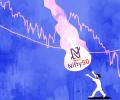
The changes will take effect on March 28, with portfolio adjustments expected before the market closes on March 27.

Among the 11 equity sub-categories, thematic funds received the highest net inflows at Rs 9,017 crore, followed by smallcap funds at Rs 5,721 crore and flexicap funds at Rs 5,698 crore.

'Stay disciplined, and remain invested.' 'Volatile times are the best to invest in structural opportunities at the right price.'

'The market's sharp decline recently has shaken the confidence of retail investors, leading to increased selling.'

The race to acquire diversified fintech firm Religare Enterprise Limited (REL) intensified as Dabur group promoters, the Burman family, said it was going ahead with the open offer on Monday and claimed that the counter offer made by US-based businessman Digvijay Gaekwad wasn't valid and will not stand scrutiny of market regulator Sebi. The Burman family claimed that the competing offer falls outside the 15-day window stipulated by the Sebi takeover code, following their initial offer on October 4th, 2023.

'The shifts in US involvement in global conflicts and geopolitical alliances could introduce uncertainties.'

Net flows from domestic institutional investors crossed Rs 5 trillion for the first time during a calendar year.

Metropolitan Stock Exchange of India (MSE) plans to raise Rs 120 crore from investors in an attempt to stay afloat. The beleaguered exchange's board has approved issuance of 1.19 billion equity shares of face value Rs 1 at a premium of Rs 1 through private placements, according to a disclosure on its website.

Zomato on Monday became the first new-age company to join the prestigious 30-share benchmark Sensex, replacing JSW Steel. This milestone marks a significant achievement not only for Zomato but also for the Indian startup ecosystem, which is increasingly making its presence felt in the $5.2 trillion listed ecosystem.

Among the new entries, the largest by market capitalisation are LIC, Avenue Supermarts (DMart), Adani Green Energy, Zomato and Jio Financial Services.

China has stayed on top for two consecutive months in the MSCI Emerging Markets Investable Market Index (EM IMI), after ceding the position to India in August. At the end of October, China's weight in the key EM gauge stood at 24.72 per cent, up from 21.58 per cent at the end of August. India's weight during this period has slipped to 20.42 per cent from 22.27 per cent.

On the cusp of launching its Rs 11,327 crore initial public offering (IPO) next week, food and grocery delivery major Swiggy believes quick commerce to be its future growth engine and anticipates that it will outpace its core food delivery business over the next five years. Currently, the quick commerce business of Swiggy - backed by Prosus and SoftBank - is 40 per cent of the size of its food delivery revenues.

Hyundai Motor India Limited's (HMIL's) record Rs 27,870 crore initial public offering (IPO) may not have set the primary market alight with sky-high subscription levels, but it has spelled a windfall for the five investment banks steering the share sale. The Indian arm of the South Korean carmaker paid Rs 493 crore - 1.77 per cent of the issue size - in fees and commissions to the book running lead managers (BRLMs), marking the largest-ever payout for an IPO in the country.
 © 2026 Rediff.com - Advertise with us - Disclaimer - Privacy Policy - Sitemap - Feedback - About us - Terms of use - Grievances